LCRA Hydrologic Data  
  

Hydromet FAQ

This FAQ also includes the River Operations Center Customer Survey FAQ as an addendum

Q: Does LCRA use the information to issue flood warnings?
Q: How many gauges are in LCRA's Hydromet network?
Q: What do the gauges measure?
Q: What is streamflow?
Q: What is stage?
Q: How do the gauges measure stage level?
Q: What is flood stage?
Q: How do I find out the flood stage at a given location?
Q: Rainfall is measured over what period?
Q: On the rainfall pages, what does "count" refer to?
Q: How is the rainfall measured?
Q: What is "conductivity data" and "micromhos"?
Q: How often is the information updated?
Q: How is the information transmitted?

Q: Does LCRA use the information to issue flood warnings?
A: No, the National Weather Service is responsible for issuing flood warnings. LCRA's data is supplied to the National Weather Service's River Forecast Center in Fort Worth to help forecasters decide whether to issue flood and weather warnings.

Q: How many gauges are in LCRA's Hydromet network?
A: As of June 2006, there are approximately 226 gauges in the system. LCRA plans to add about 28 more gauges to the network in the next few years.

Some specialized gauges are not included on this map, including ones used to monitor irrigation operations.

Q: What do the gauges measure?
A: The network supplies hydrological information on river stages, lake levels and streamflows. It also displays meteorological information including rainfall, air temperature and humidity.

The gauges are equipped with a small computer designed to operate in harsh conditions and radio equipment to transmit the data over LCRA's 900-megahertz radio towers.

Q: What is streamflow?
A: The rate at which water flows. This is measured in cubic feet per second (cfs). One cfs is equal to about 450 gallons per minute.

Q: What is stage?
A: A measure of a river's height, though it usually doesn't correspond with the natural bottom of the channel since the riverbed changes over time. Instead, the stage is determined from a benchmark where all the measurements are taken. Typically, these readings are set below the natural bottom of a channel.

Q: How do the gauges measure stage level?
A: Some locations have a pressure sensor that monitors variations in the back pressure of air bubbles in a water line. It then translates the data into depth in feet.

Q: What is flood stage?
A: Flood stage refers to the height (or stage) of a river or stream at which point the water flows out of its banks and could result in flooding or damage of adjacent land or property.

Q: How do I find out the flood stage at a given location?
A: Currently, the map does not display flood stage levels, which are determined by the National Weather Service. Not all locations have a predetermined flood stage level. To check the flood stages in the Colorado River basin, see the West Gulf River Forecast Center's Web pages on the Colorado.

Q: Rainfall is measured over what period?
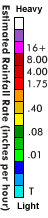
A: Rainfall is measured over three periods: the past 24 hours, since midnight and in the past hour. You can select one of these categories from the drop down menu at the top right of each page.

You also can choose to see the amount of precipitation by clicking a rainfall gauge on the map. You will see the rainfall that has accumulated during the past 24 hours, which is the default setting. To check for a different period, select from the drop down menu at the top right of the page. You also can see rainfall summary with information displayed over one-, three-, six-, and 24-hour periods, plus since midnight.

Q: On the rainfall pages, what does "count" refer to?
A: A "count" refers to one-hundredth of an inch of rain.

Readers will notice the "counts" are the accumulated numbers over time at a specified location. To find the amount of rainfall during the past 24 hours or other period, use subtraction.

Q: How is rainfall measured?
A: Inside many Hydromet locations is a device that has been likened to a "teeter-totter." This measures rainfall by using a funnel attached to a small “tipping bucket.” Each time one-hundredth of an inch of rain falls, the bucket tips; a computer records the number of tips or "counts."

Q: What is "conductivity data" and "micromhos"?
A: The network includes two instruments to remotely measure the water's conductivity -- the ability of water to pass an electrical current.

Conductivity is one way to determine the quality of the water. It is an indirect measure of the water’s salinity. Higher conductivity readings can come from inorganic dissolved solids such as chloride, sulfate, sodium and calcium.

LCRA installed these instruments on the western edge of the watershed to act as an early warning system to detect when the water has a high level of salt and other dissolved solids -- as periodically happens in this area of Texas. When high levels are detected, LCRA can notify agricultural and municipal officials so they can take protective measures.

Conductivity is measured in micromhos or microsiemens per centimeter (µs / cm). At these sites, normal levels are about 700 and 1,000 µs /cm, higher than in most of the lower Colorado River watershed. Readings of 2,000 µs /cm or more may trigger a notification.

Q: How often is the information updated?
A: Every hour. While the remote sensors send information more frequently, the Hydromet system takes a "snapshot" of this information and displays it on its Web site once an hour.

Q: How is the information transmitted?
A: The network sends a continuous stream of data via radio to a central computer at LCRA's River Operations Center in Austin. LCRA hydrologists, engineers and other experts use the information to develop forecasts and analyze trends, and to share the information with the public over the Internet.

River Operations Center Customer Survey FAQ

LCRA thanks the many people who took time to answer our customer survey earlier this year. We will be using your feedback to help improve the Hydromet Web site. In the meantime, here are answers to some frequently asked questions.

Q: On the River Report, can you show when you will release water the day before instead of the day after?
Q: Can you display real-time electric generation and floodgate operations on the Hydromet Web site (http://hydromet.lcra.org/)?
Q: Can you post the scheduled number of hours for releases for tomorrow and the next day?
Q: What are the definitions of ‘Mean Flow’ and ‘Target Instream Flow’?
Q: Does LCRA have an e-mail alert system?
Q: How is the lake level for Lakes Buchanan and Travis forecasted?
Q: Why does the level of Lake Travis sometimes decline during periods when the inflow of water is greater than the releases?

Q: On the River Report, can you show when you will release water the day before instead of the day after?
A: In the River Operations Center we schedule the minimum number of hours to release on a given day and the hydroelectric generation takes place when there is an electrical demand. Because of the competitive nature of the state’s wholesale electricity market, the exact times we plan to release water is considered confidential information and can change daily and even hourly. The best way to estimate what times the releases may occur on a given day is to check the hours releases took place on the day before. Releases typically take place around the same time each day for several days in a row. Also, in the winter releases will typically take place in the morning and evening hours, when it is coldest and in the summer they will normally take place during the afternoon and evening, when it is the hottest.

Q: Can you display real-time electric generation and floodgate operations on the Hydromet Web site (http://hydromet.lcra.org/)?
A: LCRA cannot display real-time hydroelectric generation data on the Web because it is confidential information for competitive reasons. However, we are continuing to plan improvements to the Hydromet Web site that will include more information about generation from the previous day. Keep an eye on the Web site for upcoming improvements.

Q: Can you post the scheduled number of hours for releases for tomorrow and the next day?
A: We prepare the hydroelectric generation schedule two days in advance and may add that information to the Daily River Report at a later date. However, the schedules are subject to change with little or no notice.

Q: What are the definitions of ‘Mean Flow’ and ‘Target Instream Flow’?
A: Mean Flow or Mean Discharge is the arithmetic mean of individual daily mean discharges of a stream during a specific period, usually daily, monthly, or annually.
Target Instream Flow requirements meet the desirable flow needs during the periods of normal or above normal streamflow conditions. Target flows are adjusted to emulate natural seasonal variation in the flow regimes, since the native fish community is adapted to seasonal fluctuations in flow.

Q: Does LCRA have an e-mail alert system?
A: LCRA recently launched the Floodgate Operations Notification Service (FONS), which allows people who live downstream of one of the LCRA-operated dams to subscribe to a free service to alert them of pending floodgate operations. Those who sign up can specify how they are notified: by e-mail, land line and/or cell phone. For answers to questions and a link to sign up, go to http://www.lcra.org/water/fons.html.

Additionally, LCRA has an e-mail alert service that allows people to receive e-mail alerts when LCRA issues news releases. To sign up for this free service, go to the e-mail products sign-up page at http://www.lcra.org/about/newsletters_signup.html.

Finally, using the Hydromet data Web site and weather forecasts at your home or work can be extremely helpful in staying up-to-date with current conditions by monitoring stream and lake levels and rainfall.

Q: How is the lake level for Lakes Buchanan and Travis forecasted?
A: LCRA forecasts lake levels using computer formulas developed by LCRA’s hydrologists. For Lake Buchanan, hydrologists use a program that automatically uploads the latest information on the amount of water that has flowed into the Highland Lakes chain for the day, as well as the latest estimates for up to 60 days on the amount of projected inflows, evaporation rates, and outflows/discharges.

For example, to forecast the elevation of Lake Travis, LCRA hydrologists consider a number of variables. These include the releases from Lake Buchanan, the estimated evaporation rate, outflows from the City of Austin, irrigation orders and environmental releases.

In the end, LCRA staff forecasts the levels for both lakes by making changes in the storage equation of inflows minus outflows for each lake.

Q: Why does the level of Lake Travis sometimes decline during periods when the inflow of water is greater than the releases?
A: The answer relates to the peculiarities of where the releases are measured and where the City of Austin draws water from the Colorado River.

The Colorado River is the main source of water for Austin. Austin pumps water from the river and pipes it to three water treatment plants. The two largest water treatment plants, Davis and Ullrich, draw water from Lake Austin above Tom Miller Dam. Releases from the Highland Lakes are measured at Tom Miller Dam, and do not include the water taken by the City from Lake Austin. (Note for newcomers: Lake Austin is the lake below Lake Travis on the chain of Highland Lakes.

By the way, on average, the City draws more than 150,000 acre-feet per year from the Colorado River. That’s 134 million gallons per day (mgd). This is roughly equivalent to 8.5 feet from Lake Travis. Evaporation from Lake Travis also causes lake levels to decline even when no water is released from the lake. Evaporation accounts for about four feet of loss per year.

Back to Customer Survey FAQ

Back to top of page